

Building real connection through structured social events | Mini whitepaper for The Social Circle. Proposed solutions. Let's get started!
What started as “I want to do more public speaking” has slowly morphed into something much bigger. I’m building an organization called (for now) The Social Circle, and the main objective is fighting the loneliness epidemic. Not just talking about it on a stage—actually doing something about it. Hosting structured social events specially designed to help people connect.
Follow the project on Instagram: @thesocialcircle.dc
My ah-ha moment: naming the problem, recognizing shame
The topic had been secretly living in my YouTube content for years, but it lacked clear labeling. However, once I grouped everything under “human connection and loneliness,” something clicked.. It was like discovering a forgotten jar in the back of your fridge—but this jar contained just the ingredient you needed to cook a feast.
Now, after interviewing dozens of people about loneliness, I found that everyone has personal experience with it. That alone feels like proof the mission is necessary.
Why had I avoided naming the problem for so long? Shame. People can feel ashamed about being lonely. They might feel something is wrong with them, and blame themselves for struggling to connect (as I once did). This is false!
But in any case, that shame keeps us from talking about it, which makes it worse. Part of The Social Circle’s mission is to drag this discussion into the open so it loses its grip on people. As Brené Brown shows in “Daring Greatly,”
Shame derives its power from being unspeakable. … If we cultivate enough awareness about shame to name it and speak to it, we’ve basically cut it off at the knees. Shame hates having words wrapped around it. If we speak shame, it begins to wither. Just the way exposure to light was deadly for the gremlins, language and story bring light to shame and destroy it.
Brené Brown
What makes our events unique
Here’s the philosophy behind our event design; this is what makes our events different.
Passive vs. active connection
Most events are based on what I’d call passive connection—you show up to a picnic, a party, and it’s entirely up to you to make something happen.
For shy people, this can lead to standing near the chip bowl for two hours and going home feeling worse. And even if you aren’t shy, many of us lack the social skill, mindset, or resources (e.g. love and confidence) to connect effortlessly when meeting new people.
These passive connection-based events all feel totally normal and have worked well ..in the past. But in the modern western world, we need to be more intentional about forming and maintaining relationships. Thus, our events practice active connection, which essentially assists people in connecting. I’ll come back to how this works.
Why do we need to be more intentional in connecting with others in the 2020s?
Many systemic factors prevent connection in the modern age
In America:
technology/internet/social media
individualistic/capitalistic culture
culture of busy-ness, hurry
remote work
ease of transport, transience in cities
urban planning/physical distance
lack of institutions that provided a default social context before, e.g. churches, schools
lack of spiritual community or involvement
economic forces/poverty (reducing time for connection)
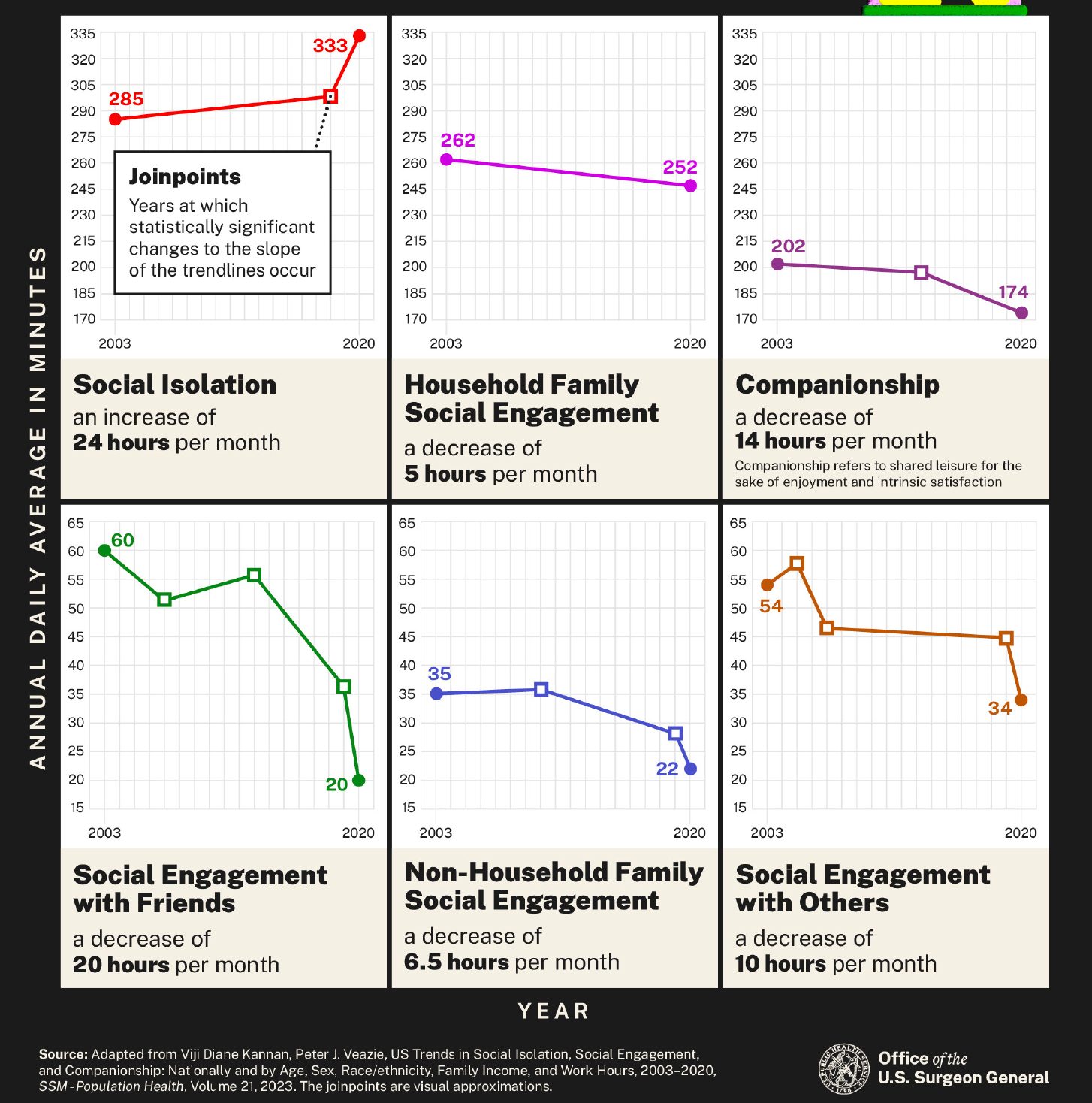
The combination of these factors has led to a decrease of 20 hours/month in our time spent with friends since 2003, and an increase in 24 hours/month in time spent alone.1 That’s like spending 10 fewer days with your friends per month (assuming a 2-hour hang out on each day)!
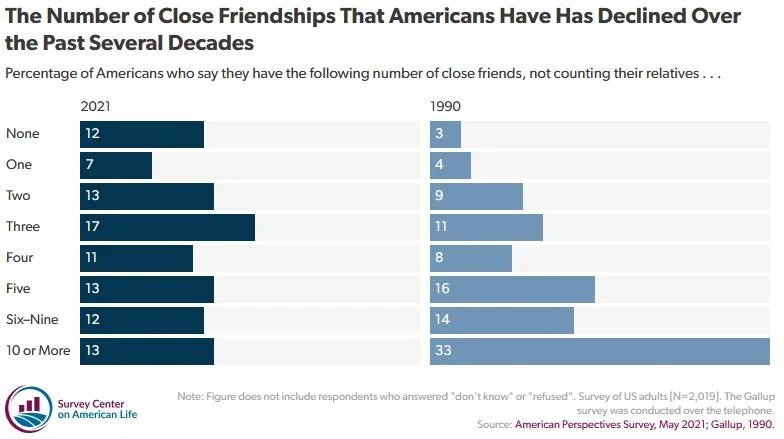
Meanwhile, the fraction of Americans with no close friends has increased by 4-fold since 1990 (3% in 1990 to 12% in 2021).
Active connection
Our events are designed around active connection: structured relational games, guided conversations, journaling prompts, vulnerable sharing. All our activities are empirically-based and demonstrated to be conducive to deeper connection-building. This helps people actually reach each other and be seen instead of just orbiting in the same room.
Learning + socializing in a safe context
Each event has two parts: an educational talk (that’s where I come in) and a social component where the structured activities happen. The first session we ran taught about the simple act of initiating—just reaching out, showing up, making the first move. Later sessions cover a range of topics impacting one’s ability to connect, such as vulnerability and authenticity, shame and self-worth, social skills, etc. The goal here is to equip people with the knowledge, beliefs, and mindsets to connect better and form deeper relationships with friends and partners.
But the educational component is only one part of it. Importantly,
Our job is not only to educate, but to create a social context in which deeper connection becomes possible.
The role of social context
The social context is key because it facilitates positive interactions that can lead to longer term connection. We strive for a warm, welcoming, nonjudgmental, empathetic atmosphere, without any kind of pressure. It’s a space where your unique story can be heard. A space which makes it feel safe to share what’s really going on in your world.
The idea of creating a context specifically conducive to connection2 was successfully modeled by programs like The Connection Project. The program, currently running at University of Virginia, Virginia Tech, and Georgetown University, involves one semester of weekly, facilitated gatherings of undergraduates.
At each gathering, students engage in relational exercises that involve sharing their experiences. Many of the activities are designed to expose the struggles that students might feel alone in.
This creates a context for connection unlike any other in their university life.
Programs that instead seek to change the broader context within which young people live, rather than providing purely didactic information, are far more likely to be successful… The Connection Project is an in-school, experience-based group intervention designed to change this peer context.3 (Allen et al. 2021)
At 4-month follow ups after the program, they found it gave undergraduate students a much deeper sense of belonging at their university.
In the same way, it’s crucial that Social Circle events create the right context; this context carries over into cultural values of the community.
Specifically, we want the community to carry cultural values which facilitate healthy, long-lasting connection: Authenticity, vulnerability, empathy, self-worth, and a genuine care for others.
At this stage, the group will be for a faith-based audience; Biblical wisdom/values will guide the content. But I hope to expand it to include secular groups later.
Case study
I experienced the power of events like these first-hand this past year.
My friend Christine hosted a series of gatherings where we slowly made our way through an online faith-based course. The event made me feel connected and seen in a way I hadn’t experienced before. What was it about these events?
About 10 of us, more or less the same group of people in their 30s, gathered in an apartment every Thursday. I didn’t know anyone. We cooked some dinner, watched a short video (usually a panel discussion/lecture), and then discussed.
The discussion questions, provided by the course, encouraged us to share more openly the struggles we were going through. They allowed us to reflect on our experiences and let our stories be heard. We also answered thoughtful journaling prompts.
I found myself consistently challenged to be more authentic/vulnerable about my inner world. Most importantly, the host created an atmosphere where it felt safe to let one’s guard down and share what was really going on. I often left feeling a soul-soothing warmth. At the Social Circle, I’m hoping to give people the same gift.
This setup, combined with a consistent group and meeting time allowed me to form friendships that are still going strong today!
A call for help
“Fighting the loneliness epidemic is a cause that not too many people are working on, at least not as many as there should be, considering how widespread the problem is.”
-Michael Lin
My longer-term vision is genuinely ambitious: multiple events running across different locations, stratified by age, geography, and faith-based vs. secular communities. And to get there, we need more facilitators and other speakers.
We also need marketers and social media managers. Marketing this thing has been its own distinct challenge. For example, you can’t call it “a room for lonely people.” Nobody would show up to that. The framing has to be positive, connection-forward, and inviting—not a diagnosis.
I know there is a strong demand for this type of event because I’ve been to some where hundreds of people showed up. One was by Profs and Pints DC called “The science of friendship.” A professor who researches friendship gave a talk. We formed small groups and were guided through discussions which encouraged vulnerable sharing.
As people stood up one-by-one during the Q+A, sharing their stories, you could feel the empathetic resonance in the room; connection is something we are all lacking. I like to say that “the momentum is already there.” It’s just a matter of getting the word out about these events..
If you would like to follow this project, check out @thesocialcircle.dc and Partiful
1 Office of the Surgeon General (OSG). Our Epidemic of Loneliness and Isolation: The U.S. Surgeon General’s Advisory on the Healing Effects of Social Connection and Community [Internet]. Washington (DC): US Department of Health and Human Services; 2023–. PMID: 37792968.
2 Through a therapeutic lens, the authors of the The Connection Project state, providing this kind of social context could be classified as “social intervention.” This is novel approach; it contrasts with more traditional forms of therapy such as behavioral, psychological, and spiritual interventions. Behavioral intervention seeks to address/modify outward behavior (for e.g. social skills), psychological addresses mindset, emotional regulation, and beliefs, and spiritual intervention addresses beliefs and one’s connection with God.
3 Allen, Joseph P., et al. “The Connection Project: Changing the peer environment to improve outcomes for marginalized adolescents.” Development and Psychopathology 33.2 (2021): 647-657.
